Uber Accidents on Highways vs. City Streets in Texas


Every article on this site is researched by our internal team, reviewed for legal accuracy against current Texas law, and held to State Bar of Texas advertising standards before publication. We do not publish content that overstates outcomes or makes promises about results.
Learn more about our
editorial standards .
Key Takeaways
- Crash location changes liable parties and injury severity, but not the Uber coverage period.
- Highway Uber crashes often add a truck company or road authority as a liable party.
- Texas gives you two years from your Uber crash to file an injury lawsuit.
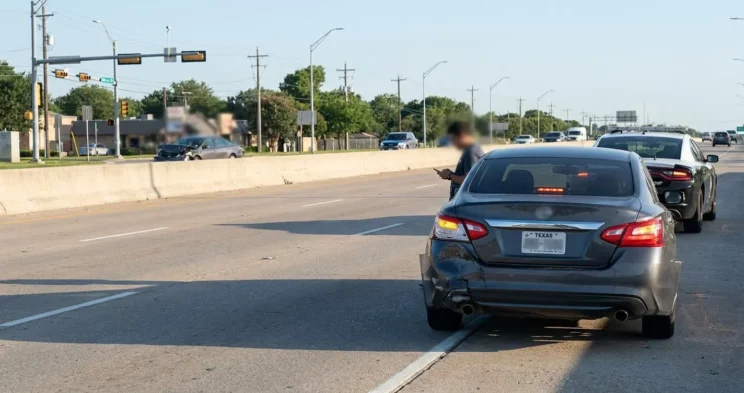
You were riding home from a late dinner near Midtown Houston when your Uber driver merged onto I-45, and a pickup truck clipped the rear bumper at speed. Your Uber spun, your shoulder slammed the door, and now you are staring at an ER bill, wondering who pays for any of this.
While part of what is racing through your head is whether it even matters that this happened on the freeway and not on a city street, it matters more than most people expect.
Highway vs. City Street Uber Crashes in Texas
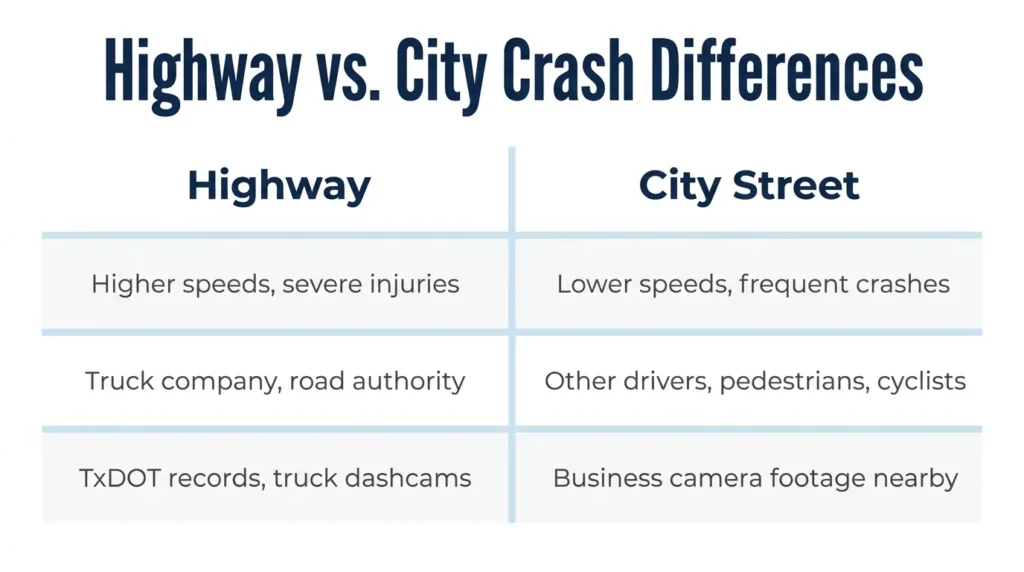
Where your Uber crash happened affects who you can hold responsible and how much your injuries are likely worth, but it does not change which Uber insurance kicks in. That single distinction shapes most of the decisions you will face next.
Highway Uber crashes usually happen at higher speeds. They tend to cause more severe injuries, and they often pull in extra parties like a commercial truck company or the agency responsible for a poorly designed stretch of road.
City street crashes are the more common scenario. They usually happen at lower speeds, but they bring their own complications: more pedestrians and cyclists nearby and tangled fault at busy intersections.
Sorting out a rideshare crash on a city street versus a highway often comes down to how many people share the blame.
The road type does not decide which Uber coverage period applies to your wreck. What it does decide is who else might owe you money and how badly your injuries drive up the value of your claim. Our Texas rideshare accident claims page walks through how that coverage framework fits together.
Injury Severity & Liable Parties by Location
The faster the crash, the worse the injuries, and the more parties tend to be involved, which is why a highway Uber wreck and a city street wreck can look like two entirely different claims.
Highway crashes on Texas freeways often produce catastrophic harm. High-speed impact, rollovers, and chain-reaction collisions can leave you with injuries that take months or years to heal. If a commercial truck contributed to your crash, our truck accident cases page explains how liability against the trucking company works.
City street Uber accidents bring different risks. You are more likely to see pedestrians and cyclists in the mix, and fault often splits across several drivers at an intersection, a pickup zone, or a busy nightlife block.
There is sometimes another layer in urban crashes. When a pothole, a broken signal, or an unmarked hazard caused the wreck, a city or county may share the blame. The Texas Civil Practice and Remedies Code (CPRC) Chapter 101 sets the narrow path for holding a government entity responsible, and those claims carry strict notice deadlines.
Figuring out every party who owes you money can take a careful review of evidence you may not even know to save, which is one reason preserving crash evidence early matters in these cases.
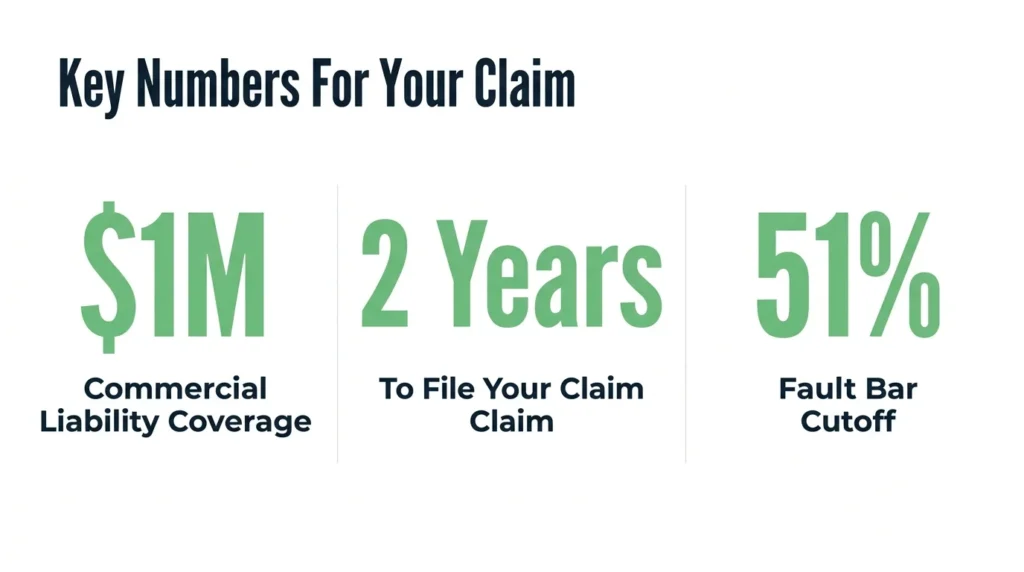
When more than one driver shares the blame on a highway, Texas uses a fault-sharing rule to decide who pays. Under the Texas Civil Practice and Remedies Code § 33.001, if you are found 51% or more at fault, you recover nothing. Below that line, your recovery shrinks by your share of the blame.
Uber Insurance Coverage Periods & Location
Uber’s insurance breaks into coverage periods based on what the driver was doing, and the same period applies whether you crashed on a freeway or a side street. The Texas Insurance Code Chapter 1954 sets the minimum coverage these Uber and Lyft insurance periods must carry.
The big commercial policy covers up to $1 million in liability once the driver has accepted a trip or has a passenger in the car, no matter the road type. A highway crash and a city street crash both reach that same coverage tier. You can see how the periods break down in our guide to Uber and Lyft coverage periods.
The gap shows up in Period 1, when the app is on but the driver has not yet accepted a ride. During this window, coverage drops to lower contingent minimums. A high-speed highway crash in Period 1 is far more likely to leave injuries that blow past those minimums, which is when the aftermath of an Uber accident gets incredibly messy.
A driver’s insurance compliance status often becomes a key piece of evidence in any coverage dispute. Whether the driver met state requirements at the moment of the crash can decide which policy actually pays.
Evidence Collection Differs by Crash Location
The proof you can gather depends heavily on where the crash happened, and the window to collect it is short either way. Acting fast protects the facts before they disappear.
Highway crashes often draw law enforcement from more than one agency, along with TxDOT data and possible black box or dashcam records from a commercial truck. That evidence can vanish quickly, so the sooner someone requests it, the better.
City street crashes usually offer more camera coverage from nearby businesses and traffic systems. The tradeoff is that witness memories fade, and intersection conditions change, so prompt gathering of evidence matters.
Texas also imposes a reporting duty no matter the road type. Under the Texas Transportation Code § 550.026, drivers involved in a serious crash must report it right away, and that includes Uber drivers.
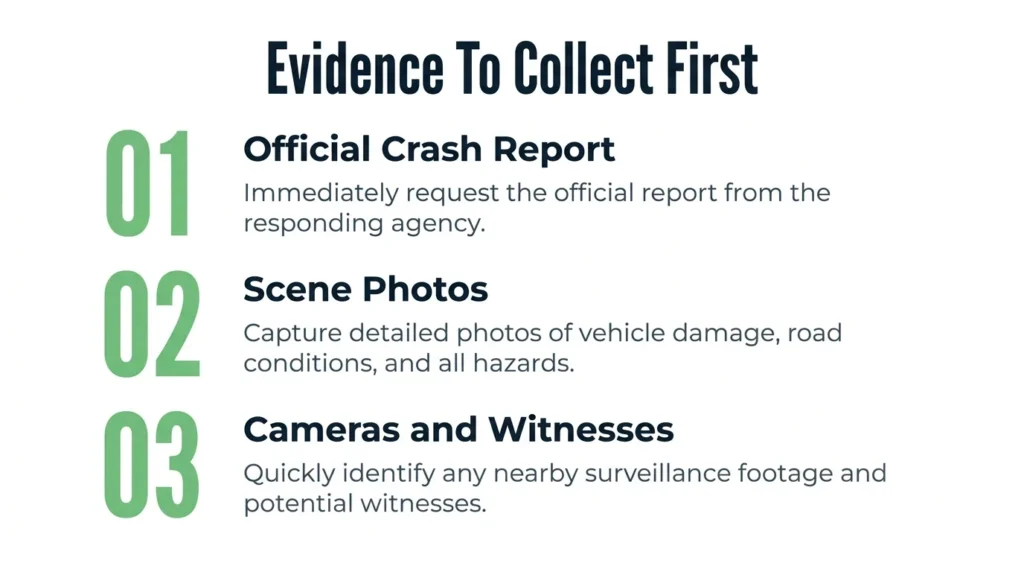
If you are not sure what to save after your crash, the steps below cover the basics for both highway and city street wrecks.
Step 1: Get the official crash report. Request a copy from the responding agency. On a highway wreck, more than one department may have responded, so confirm which one filed the report.
Step 2: Capture the scene before it changes. Photograph vehicle damage, road conditions, signals, and any hazard, like a pothole, that may have played a role.
Step 3: Identify cameras and witnesses fast. On city streets, check nearby businesses for footage. On highways, ask about commercial truck dashcams and black box data.
Step 4: Document the Uber trip status. Screenshot your ride details so the coverage period is clear later.
One deadline applies to all of these claims. Texas gives most injured people two years from the crash date to file under Texas Civil Practice and Remedies Code § 16.003, whether the wreck happened on a freeway or a city street. If you are weighing your options, our guide on whether you can sue Uber after a crash breaks down what that process looks like.
Contact Angel Reyes & Associates After Your Uber Crash
Whether your Uber crash happened on a Texas highway or a city street, the real questions are the same: how badly were you hurt, which coverage period applied, and who shares the blame. Angel Reyes & Associates handles both kinds of crashes, and we have guided injured Texans through this process for over 30 years.
We work on contingency, which means no fee unless we win, and your first consultation is always free. We have more than $1 billion recovered for clients across the state, and you can read about our results and client experiences to see how we work.
We answer the phone 24/7 and serve injured people across all of Texas, with more than 20 offices throughout the state. If you want a clearer picture of what your case could be worth, our breakdown of the average Uber accident settlement in Texas is a good place to start.
When you are ready, reach out to us for a free consultation, and we will walk you through your options.
Past results do not guarantee future outcomes.
Uber Accidents: Highways vs. City Streets FAQs
Can a pedestrian or cyclist hit by an Uber in Texas file a claim against Uber's insurance?
Yes, pedestrians and cyclists struck by an Uber driver can file a claim against Uber’s insurance, and the coverage that applies depends on what the driver was doing at the time of the crash. If the driver had accepted a trip or had a passenger in the car, Uber’s $1 million commercial liability policy is available to cover their injuries.
What notice deadline applies when a city road defect contributed to my Texas Uber crash?
Before you can sue a Texas city for a road defect, you must file a formal notice of claim, typically within six months of the crash under the Texas Tort Claims Act. Some cities require shorter notice, with Houston requiring written notice within 90 days, so checking your city’s local rules quickly is worth doing.
How fast can a commercial truck's black box data disappear after a highway crash?
Event data recorder information from a commercial truck can be overwritten in as little as 30 to 45 days if the truck keeps operating after the crash. Sending a formal preservation letter to the trucking company right away is the only way to legally require them to hold that data.
Can an Uber passenger file a claim against both the Uber driver and another at-fault driver at the same time?
Yes, an Uber passenger can pursue claims against every driver who shares fault for the crash, whether that is one driver, two, or more. Texas’s fault-sharing rules allow you to collect from multiple parties, with each one paying their share of the total damages.
If someone in another vehicle is injured when an Uber crashes into them, does Uber's insurance cover them?
Uber’s $1 million commercial liability policy during an active trip covers not just passengers but also people in other vehicles and pedestrians injured by an at-fault Uber driver. That coverage applies for both highway and city street crashes as long as the driver had accepted a ride or was carrying a passenger at the time.
About the Authors

Angel Reyes
Writer
Angel L. Reyes, III is the Founder and Managing Partner of Angel Reyes & Associates. A nationally recognized trial attorney and business leader, Angel has helped over 70,000 injury victims recover more than $1 billion since founding the firm in 1993. Named to the Texas Super Lawyers list annually since 2008, Angel brings Wall Street experience, Ivy League education, and a deep commitment to client advocacy. He is a frequent legal commentator and published author with extensive contributions to legal scholarship, trial strategy, and consumer protection.

Kyle Nicolas
Editor
Kyle Nicolas is the Web Content & SEO Manager at Angel Reyes & Associates. He has more than 10 years of experience as a marketing co...

Angel Reyes
Reviewer
Angel L. Reyes, III is the Founder and Managing Partner of Angel Reyes & Associates. A nationally recognized trial attorney and business...