Uber Eats Delivery Driver Accident Liability


Every article on this site is researched by our internal team, reviewed for legal accuracy against current Texas law, and held to State Bar of Texas advertising standards before publication. We do not publish content that overstates outcomes or makes promises about results.
Learn more about our
editorial standards .
Key Takeaways
- Uber Eats coverage runs from $0 to $1 million depending on the driver's delivery phase.
- Active deliveries trigger a $1 million Uber Eats policy, the cleanest path to recovery.
- Texas gives you two years from the crash date to file an Uber Eats injury claim.
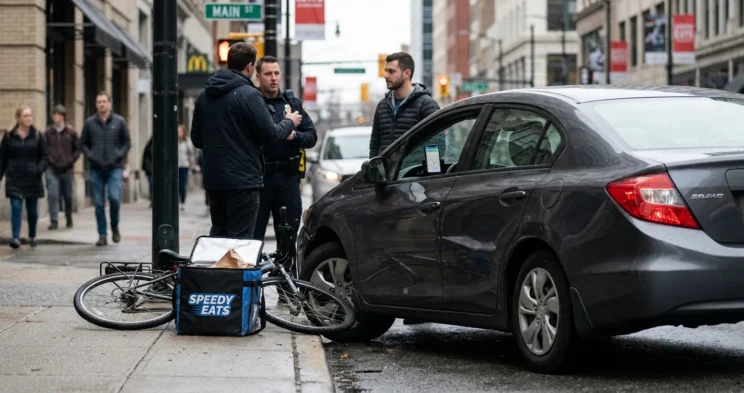
You were turning onto Westheimer Road near the Galleria when a driver with a glowing delivery bag on the passenger seat ran the light and clipped your front bumper. Now your neck hurts, your car is in the shop, and you have no idea whose insurance is supposed to pay.
Was that driver even “on the clock”? The answer changes everything about your claim.
How Uber Eats Coverage Periods Work
Three separate insurance phases decide who pays after an Uber Eats crash, and each one offers a very different amount of money. The phase the driver was in when they hit you controls how much coverage is available to you.

In Phase 1, the app is off and the driver is not working. Only the driver’s personal auto policy applies. Many personal policies exclude commercial use, so coverage can be thin or denied outright.
Phase 2 begins when the driver logs in but has not yet accepted an order. Uber Eats provides contingent liability coverage of $50,000 per person, $100,000 per accident, and $25,000 for property damage. That coverage only kicks in when the driver’s personal policy does not apply or falls short.
Phase 3 is the active delivery window, from the moment the driver accepts an order through drop-off. Here, Uber Eats carries a $1 million liability policy. This is the widest coverage window and the cleanest path for an injured third party to recover.
Understanding uber eats driver insurance coverage is important because Phase 2 is the most contested window in any food delivery driver accident liability dispute in Texas. Personal insurers point to commercial-use exclusions to deny the claim. The contingent coverage only triggers after that denial, which can leave you caught between two insurers pointing at each other.
If your incident actually involved an Uber passenger vehicle rather than a delivery car, the rules shift. That’s why it’s so important to fully understand the details of these time periods.
Uber Eats vs. Rideshare Accident Claims
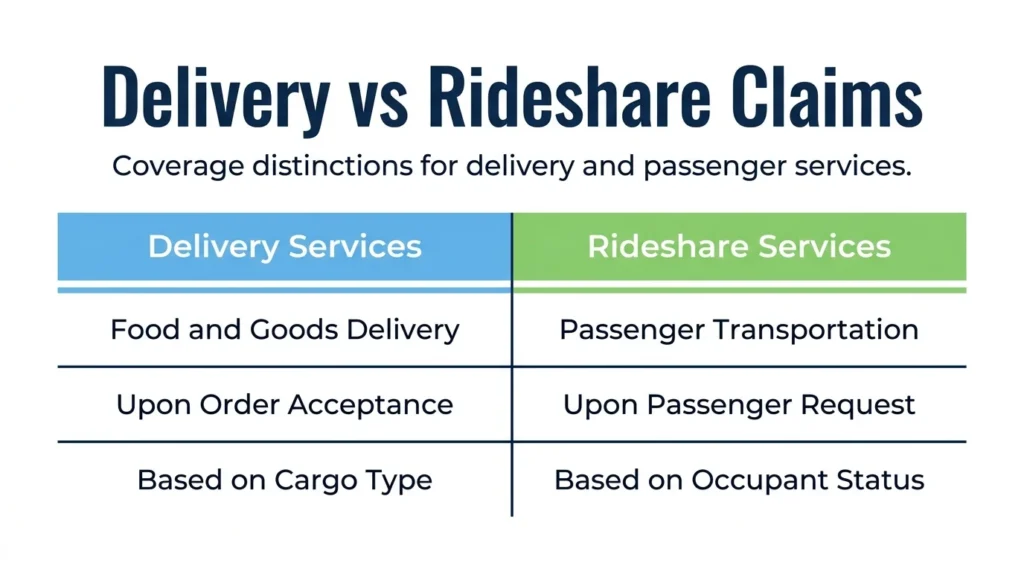
An Uber Eats claim and a rideshare passenger claim follow a similar three-period structure, but they do not produce the same result. The driver’s on-duty definition, the cargo involved, and the platform’s regulatory status all differ between the two models.
Knowing who pays when an uber eats driver causes an accident starts with the kind of trip. Rideshare drivers carry passengers, and the “engaged” period turns on pickup and drop-off of a person. You can see how that plays out in our guide to what happens when an Uber gets in an accident.
Delivery drivers carry food, not people. Courts can read the driver’s “engaged” status differently, and personal auto exclusions get applied in their own way to commercial cargo.
Both models share one defense: Uber calls its drivers independent contractors, not employees. That label is meant to limit the company’s exposure. The delivery driver’s relationship to the company can still be examined under a different lens when commercial versus personal auto coverage is in question.
Texas Law & Delivery Network Companies
Texas now regulates Uber Eats directly, and a 2025 law most articles still ignore is the reason. The Texas Insurance Code Chapter 1954 originally governed Transportation Network Companies.
Texas HB 4215, signed May 28, 2025, and effective September 1, 2025, brought delivery network companies, including Uber Eats, under a comparable state regulatory framework for the first time. The change closed a gap that had left food delivery in an unclear category. You can read the state’s official summary through the Texas delivery network company rules.
Under this framework, Uber Eats must carry the insurance minimums described above. That is what makes a delivery network company accident Texas claim more predictable than it used to be.
Texas also uses a fault-sharing system called proportionate responsibility. If you are found 51% or more at fault for the crash, you cannot recover anything under Texas proportionate responsibility law. Below that line, your recovery is reduced by your share of the blame.
You also have a clock. The two-year deadline to file a personal injury lawsuit comes from the Texas Civil Practice and Remedies Code (CPRC) § 16.003. Miss that two-year window and your right to sue is almost certainly gone.
Who Is Liable in an Uber Eats Crash?
The driver carries primary responsibility for causing the crash, but the liability chain can reach further. Whether it extends to Uber Eats depends on the facts and on which coverage phase was active.
The driver’s first legal duty is at the scene. The Texas Transportation Code § 550.021 requires any driver to stop and render aid after a crash involving injury or death.
Uber Eats then raises its standard shield: its drivers are independent contractors, not employees. That argument is meant to block respondeat superior, the rule that holds an employer responsible for an employee’s actions on the job.
That shield is not absolute. Uber eats driver accident liability can still reach the company through negligent hiring, where it knew or should have known the driver posed a risk. Negligent entrustment and the new delivery network company rules can also open the door. If you are unsure whether the driver counts as an employee or a contractor in your situation, speaking with an attorney who handles rideshare and delivery claims can clarify where you stand.
The value of your claim tracks the active coverage phase and whether liability reaches the platform. Phase 3 claims are usually cleaner because the $1 million policy leaves little room for argument, the same way a strong Texas car accident claim rests on clear coverage.
Steps to Take After an Uber Eats Accident
What you do in the first hour shapes your entire claim, because the driver’s status at the scene decides which coverage phase applies. Move through these steps in order while the details are fresh.
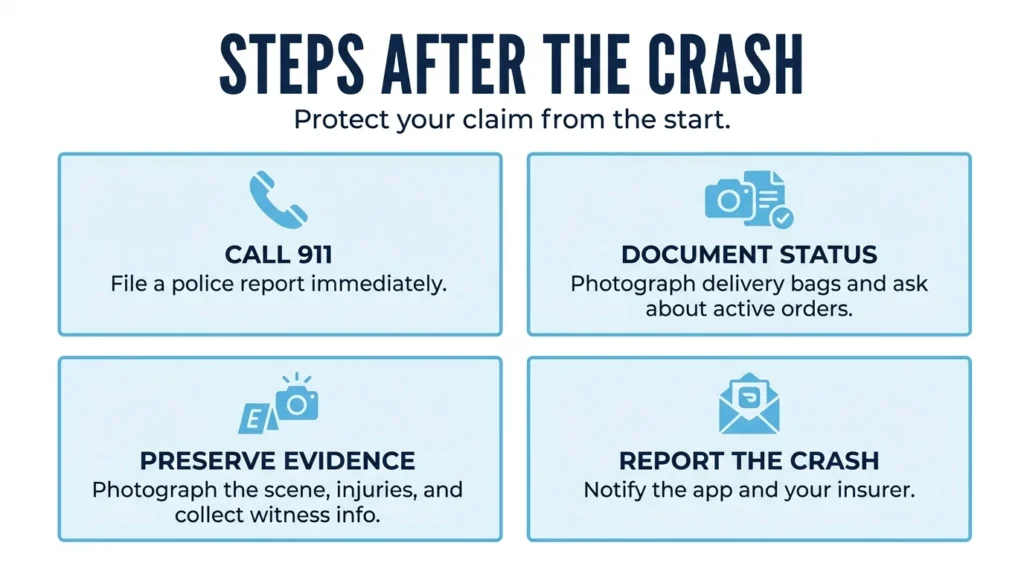
Step 1: Call 911. Texas law requires reporting a crash that causes injury, death, or vehicle damage that prevents the car from being driven. The police report becomes the factual record for your insurance claim.
Step 2: Document the driver’s status. Photograph or screenshot any delivery materials in the vehicle, and ask the driver directly whether they had an active order. Their answer points to the coverage phase that applies to you.
Step 3: Preserve all evidence. Photograph the scene, the vehicles, your injuries, and any delivery bags or Uber Eats signage. Collect contact information from every witness.
Step 4: Report the crash through the app and to your insurer. Uber’s in-app report creates an internal record that can be requested later in litigation. You can review the broader process in our guide to what to do after a rideshare accident in Texas.
Do not accept a quick settlement before you know the full scope of your injuries. Phase 3 limits are high, and an early offer can land far below what your claim is actually worth.
Talk to a Texas Delivery Accident Attorney
A crash with an Uber Eats driver can leave you arguing with two insurers while medical bills pile up, and you should not have to sort that out alone. Angel Reyes & Associates has spent over 30 years helping injured Texans handle vehicle accident claims, including crashes involving delivery and rideshare drivers.
We work on contingency, which means no fee unless we win, and we have recovered more than $1 billion for clients across the state. You can see how we have handled cases like these on our case results page.
We serve clients across Texas, we are available 24/7, and we can handle most of your case remotely. Schedule a free consultation so you understand your options before any deadline runs out.
Past results do not guarantee future outcomes.
Frequently Asked Questions
What if the Uber Eats driver had no personal auto insurance when they hit me?
If the driver was on an active delivery, Uber Eats’ $1 million liability policy still applies regardless of whether the driver carried their own coverage. For Phase 2 incidents, the contingent coverage can also trigger if the driver’s personal policy is absent or denied.
What types of damages can I recover after an Uber Eats driver causes an accident?
In Texas you can pursue compensation for medical expenses, lost wages, reduced earning capacity, property damage, and pain and suffering. Cases involving gross negligence may also support a claim for punitive damages.
Does my own car insurance play any role after an Uber Eats driver hits me?
Yes. If the at-fault driver’s coverage is disputed or insufficient, your own uninsured or underinsured motorist coverage can fill the gap. Your collision coverage may also help pay for vehicle repairs while liability is being sorted out.
What if the Uber Eats driver was running multiple delivery apps at the same time when the crash happened?
Coverage depends on which app showed an active delivery at the moment of the crash. Each platform’s insurance only covers its own active trip, so attorneys often subpoena timestamped app logs to establish which policy applies.
Does Uber Eats' insurance cover damage to my parked car if a delivery driver hits it?
Yes, if the driver had an active order at the time, the $1 million policy includes third-party property damage. If the driver was only logged in without an active order, the Phase 2 property damage limit of $25,000 applies instead.
About the Authors

Angel Reyes
Writer
Angel L. Reyes, III is the Founder and Managing Partner of Angel Reyes & Associates. A nationally recognized trial attorney and business leader, Angel has helped over 70,000 injury victims recover more than $1 billion since founding the firm in 1993. Named to the Texas Super Lawyers list annually since 2008, Angel brings Wall Street experience, Ivy League education, and a deep commitment to client advocacy. He is a frequent legal commentator and published author with extensive contributions to legal scholarship, trial strategy, and consumer protection.

Kyle Nicolas
Editor
Kyle Nicolas is the Web Content & SEO Manager at Angel Reyes & Associates. He has more than 10 years of experience as a marketing co...

Angel Reyes
Reviewer
Angel L. Reyes, III is the Founder and Managing Partner of Angel Reyes & Associates. A nationally recognized trial attorney and business...