How Long Does a Wrongful Death Lawsuit Take in Texas?


Every article on this site is researched by our internal team, reviewed for legal accuracy against current Texas law, and held to State Bar of Texas advertising standards before publication. We do not publish content that overstates outcomes or makes promises about results.
Learn more about our
editorial standards .
Key Takeaways
- Most Texas wrongful death cases settle within roughly six months to two years.
- Discovery is usually the longest stage and can run several months to over a year.
- A contested trial plus appeal can add months or years to your case timeline.
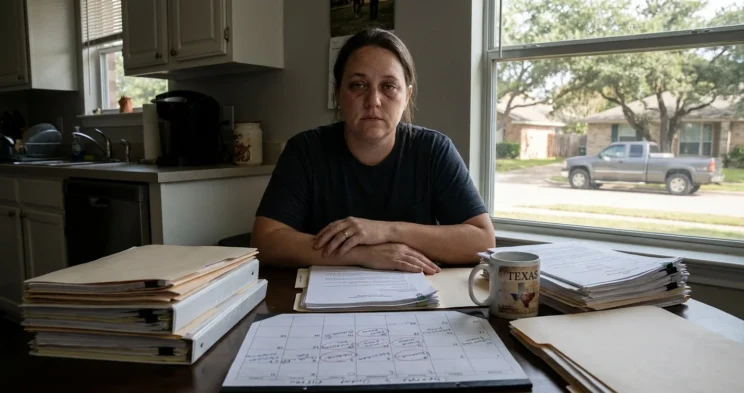
The call came on an ordinary Tuesday. A crash on I-635 near Garland took someone you love, and now people around you keep mentioning lawsuits and deadlines. Before anything else, you want to know one thing: how long is this going to take?
Wrongful Death Lawsuit Timeline Overview
Most Texas wrongful death cases run somewhere between several months and a few years, depending on how they resolve. The process moves through five stages, and each one carries its own clock.
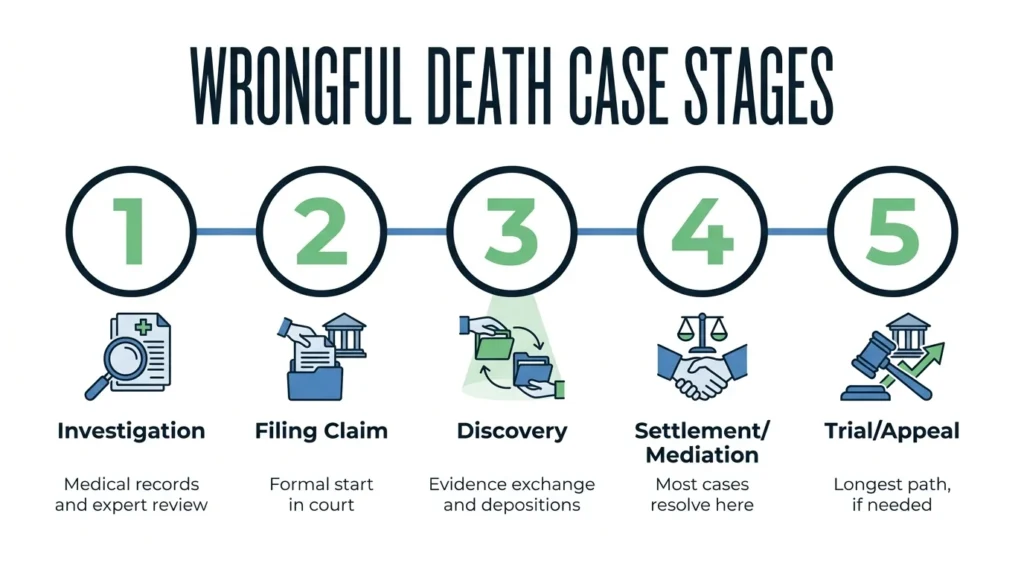
- Investigation: gathering medical records, reports, and expert review before filing.
- Filing the claim: the formal start of the case in court.
- Discovery: both sides exchange evidence and take depositions.
- Settlement or mediation: the stage where most cases resolve.
- Trial or appeal: the longest path, reached only when settlement fails.
A wrongful death claim lets certain family members recover after a loved one dies because of someone else’s negligence. Our overview of of Texas wrongful death claims explains how these cases work and who they protect.
The right to bring the claim comes from the Texas Civil Practice and Remedies Code (CPRC) Chapter 71. That law defines who can sue and on what grounds. The foundation is set before any procedural clock starts running.
Filing a Wrongful Death Claim
Before a case is filed, the investigation and evidence-gathering phase usually takes several weeks to a few months. What drives that range is how quickly medical records, accident reports, and expert reviews come together.
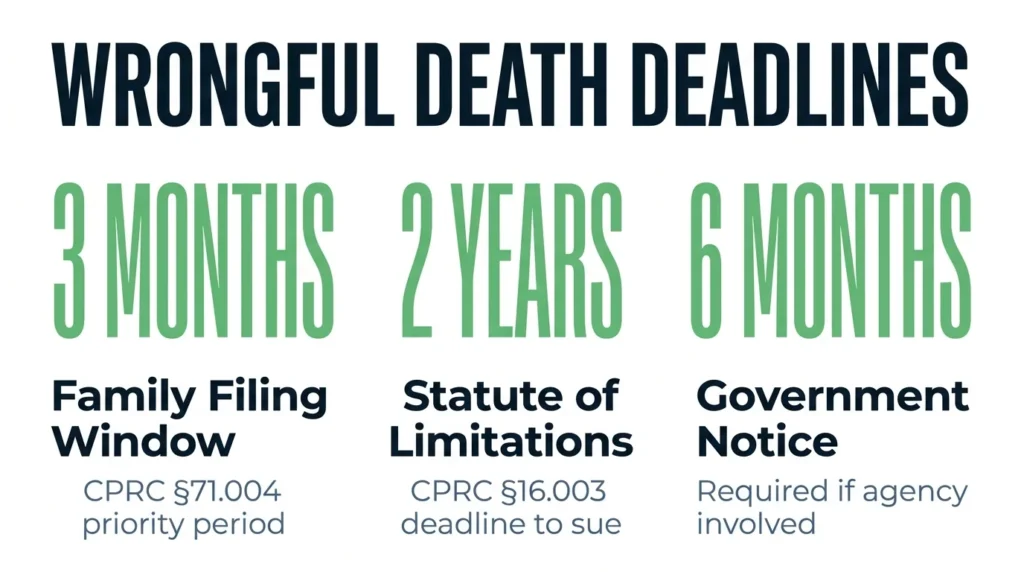
Timing also depends on who files. Texas gives a surviving spouse, children, or parents the first three-month window to file under CPRC § 71.004. If none of them act within that period, the estate’s personal representative can bring the claim instead.
Separate from the process timeline, Texas also sets a two-year deadline to file a wrongful death claim under CPRC § 16.003. Miss that window and your right to sue is almost always gone.
An attorney manages this filing stage and guides your family through everything that follows. Our step-by-step guide to filing a wrongful death lawsuit in Texas walks through the first stage.
Discovery Stage Duration
Discovery is usually the longest stage of a wrongful death lawsuit, often stretching from several months to more than a year. This is where both sides exchange documents, answer written questions, and take depositions under oath.
Depositions and expert exchanges are part of the wider litigation process. Our explainer on what litigation means in Texas injury law shows where discovery fits in the bigger picture.
Texas sorts cases into discovery control plans under the Texas Rules of Civil Procedure. Most wrongful death suits fall under a Level 2 plan, the default plan for cases seeking substantial damages, which generally runs about nine months. That framework shapes how long this stage can run.
If you want the full breakdown of what speeds this stage up or slows it down, our guide on how long discovery takes in Texas goes deeper.
Wrongful Death Settlement Timeline
Most wrongful death cases resolve in settlement, and that stage often takes several months of back-and-forth negotiation. Cases with clear liability can settle in roughly six months to two years, while disputed cases run longer.
What slows a settlement down is usually contested liability, more than one defendant, or insurance policy limits that fall short of the full loss. Each added defendant means another party negotiating on its own timeline.
Mediation often enters here, where a neutral third party helps both sides reach a number. Our look at the Texas insurance settlement timeline explains how much time that step usually adds.
Before you agree to any timeline, understand what your claim may realistically be worth, and our page on wrongful death settlement caps and damages breaks that down.
Settlement vs. Trial Duration
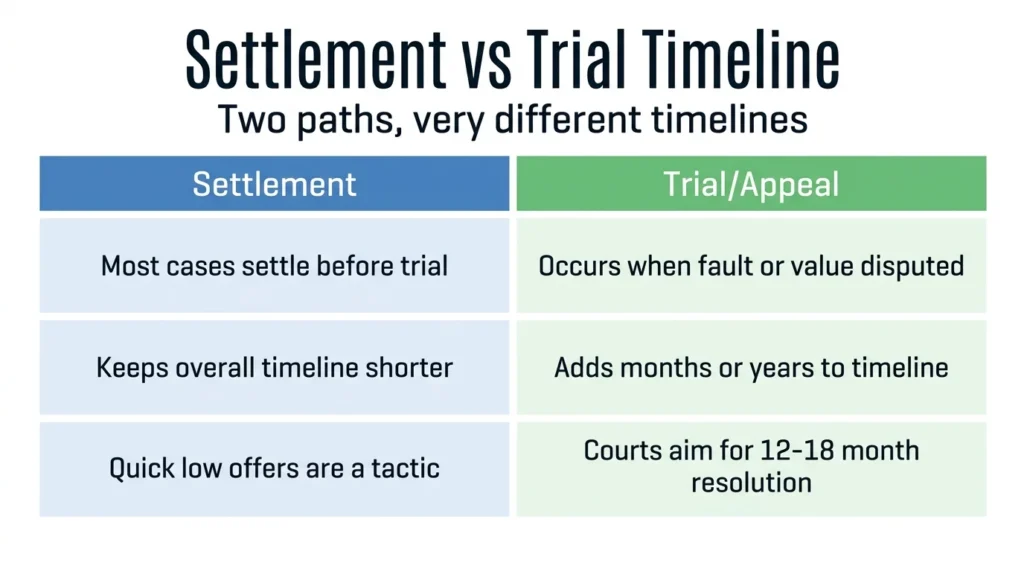
The two paths to resolution split sharply on time. Settling can close a case in months, while a trial can add a year or more to the timeline.
Settling Before Trial
Most wrongful death cases settle or mediate well before a trial date ever arrives. That keeps the overall timeline far shorter than fighting through to a verdict.
Be aware: During settlement negotiations, a quick, low offer is a business tactic. Accepting it early ends your right to ask for more later.
Going to Trial or Appeal
A case heads to trial when the parties cannot agree on fault or the value of the loss. A contested trial, plus any appeal, can add months or even years to the timeline.
Weighing a faster settlement against a longer trial is one of the hardest calls a family makes, and our look at how often injury cases go to trial can help you think it through.
Texas sets its own court disposition time standards, aiming to clear non-jury cases within 12 months and jury cases within 18 months. Those numbers give you a realistic benchmark for a case that goes the distance.
Rising civil filings and court backlogs can push even a well-prepared case past those marks, as the state’s FY24 court caseload data shows.
Work with a Texas Wrongful Death Attorney
Every stage of this timeline is easier with someone who has walked families through it before. For decades, we have guided grieving Texas families from the first investigation through final resolution, and our story and mission reflect that work.
Angel Reyes & Associates has spent more than 30 years standing beside Texas families after a devastating loss. We work on a no-fee-unless-we-win basis, so you pay nothing unless we recover for you, and your first consultation is always free. Our track record includes more than $1 billion recovered for clients.
When you are ready, schedule a free consultation, and we will walk you through your options and your likely timeline.
Past results do not guarantee future outcomes.
Texas Wrongful Death Lawsuit Timeline FAQs
Is the deadline shorter if a government agency is involved in a Texas wrongful death case?
Yes. Texas generally requires written notice to a government entity within six months of the incident, far sooner than the two-year deadline that applies to most wrongful death claims.
Does a wrongful death settlement in Texas require court approval?
Not always. If every beneficiary is a competent adult who agrees on the amount, a court usually does not need to approve it. However, a settlement with a minor beneficiary must go through a Texas court for approval.
What is the difference between a wrongful death claim and a survival action in Texas?
A wrongful death claim compensates surviving family members for their own losses, while a survival action covers the pain, suffering, and medical bills the deceased could have claimed while alive. Texas law lets families file both claims together in one lawsuit.
Can a wrongful death claim settle in Texas before a lawsuit is even filed?
Yes. Many Texas wrongful death claims settle through negotiation before anyone files a lawsuit, though the two-year deadline still applies if talks fall apart.
How long does it take to appoint an estate representative for a wrongful death claim?
In an uncontested case, a Texas court can appoint a personal representative about two to three weeks after the application is filed. Disputes among family members can add more time to that step.
About the Authors

Angel Reyes
Writer
Angel L. Reyes, III is the Founder and Managing Partner of Angel Reyes & Associates. A nationally recognized trial attorney and business leader, Angel has helped over 70,000 injury victims recover more than $1 billion since founding the firm in 1993. Named to the Texas Super Lawyers list annually since 2008, Angel brings Wall Street experience, Ivy League education, and a deep commitment to client advocacy. He is a frequent legal commentator and published author with extensive contributions to legal scholarship, trial strategy, and consumer protection.

Kyle Nicolas
Editor
Kyle Nicolas is the Web Content & SEO Manager at Angel Reyes & Associates. He has more than 10 years of experience as a marketing co...

Angel Reyes
Reviewer
Angel L. Reyes, III is the Founder and Managing Partner of Angel Reyes & Associates. A nationally recognized trial attorney and business...