What Does a Motorcycle Accident Lawyer Do?


Every article on this site is researched by our internal team, reviewed for legal accuracy against current Texas law, and held to State Bar of Texas advertising standards before publication. We do not publish content that overstates outcomes or makes promises about results.
Learn more about our
editorial standards .
Key Takeaways
- A motorcycle accident lawyer handles investigation, evidence, insurers, and settlement talks.
- You have two years under CPRC 16.003 to file a Texas motorcycle injury lawsuit.
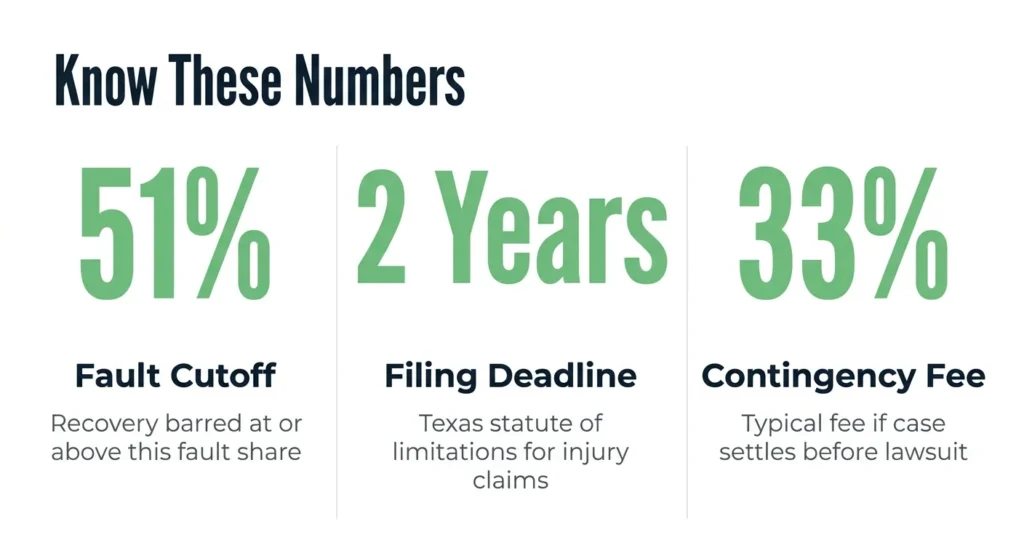
- Texas bars recovery if you are found 51% or more at fault for the crash.
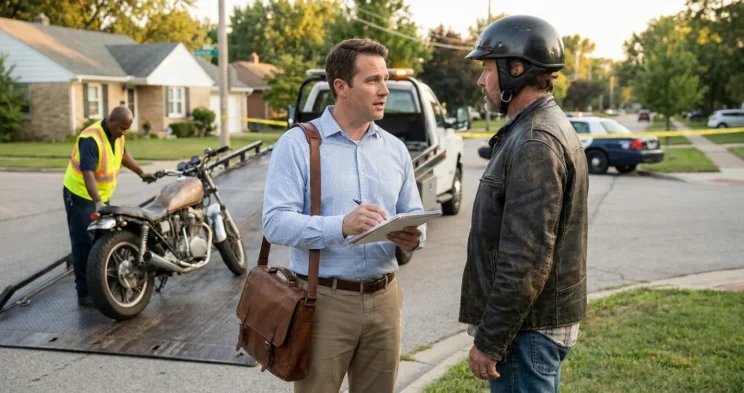
You were riding home through Deep Ellum when a driver turned left across your lane and put you on the pavement. Now your phone keeps ringing, and the other driver’s insurance adjuster is asking questions that feel like a setup. You are hurt, the bills are coming in, and you are not sure whether a lawyer is worth it or just one more cost you cannot afford.
What a Motorcycle Accident Lawyer Actually Does
A motorcycle accident lawyer runs the parts of your claim that decide what it is worth. That work breaks into five jobs, and skipping any one of them gives the insurer an opening.
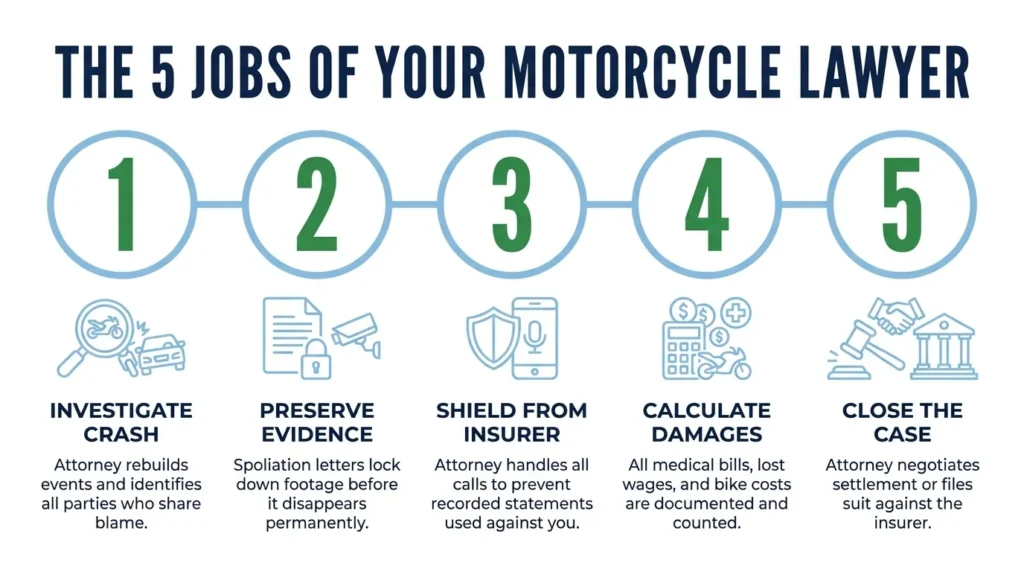
- The first job is figuring out what happened. Your attorney investigates the crash scene, rebuilds the sequence of events, and identifies everyone who shares blame. That can include the negligent driver, an employer if the driver was working, and sometimes a parts manufacturer.
- The second job is protecting evidence before it disappears. Your attorney sends spoliation letters to lock down surveillance footage, document skid marks, and pull the police report before records get purged. Motorcycle crash evidence vanishes fast, and once it is gone, you cannot rebuild it.
- The third job is shielding you from the insurer. Your attorney handles every call so you never get recorded saying something the adjuster can twist into shared fault. If you have already spoken to an insurer, our motorcycle accident claims page walks through what comes next.
- The fourth job is adding up the full damage. That means current and future medical bills, lost income, pain and suffering, and the cost of your bike. Riders who do this alone almost always undercount, and Texas crash severity data shows why the medical side runs high.
- The fifth job is closing the case. Your attorney negotiates a settlement, and if the insurer refuses to deal fairly, files a lawsuit in a Texas court.
Texas Laws That Shape Your Case
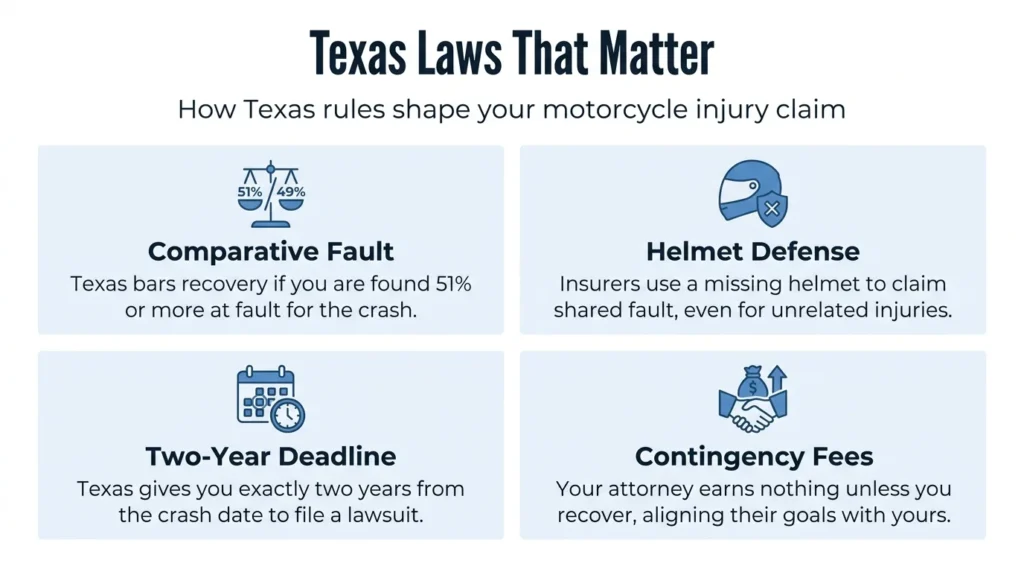
Two Texas rules give insurers their main tools for cutting a motorcycle payout: the fault-sharing statute and the helmet law. Knowing how each one works changes how your claim gets built and defended.
Texas Comparative Fault Rules
Texas uses a modified comparative fault system. If you are found 51% or more at fault for the crash, you recover nothing under the Texas Civil Practice and Remedies Code (CPRC) § 33.001. Below that line, your recovery drops by your share of the blame.
Insurers know this rule cold. They will argue your speed, your lane position, or your visibility helped cause the wreck. A few percentage points shifted onto you can cut a payout by 20, 30, or 40 percent.
An attorney pushes back with crash reconstruction and witness statements that challenge how fault gets assigned. The Texas comparative negligence 51 percent rule explains how that math can quietly shrink a recovery.
Texas Helmet Law & Insurer Arguments
Riders 21 and older may legally ride without a helmet in Texas if they meet the conditions in the Texas Transportation Code Chapter 661. Insurers still use a missing helmet to argue you share the blame, even when your worst injury had nothing to do with your head.
Your attorney attacks that link directly. If the helmet had no bearing on the injuries you are actually claiming, it should not reduce your motorcycle injury claim, and a lawyer keeps the insurer from pretending otherwise.
How Lawyers Handle Insurance Negotiations
Negotiation starts with a demand package and rarely ends with the insurer’s first number. Your attorney compiles your medical records, bills, lost wage proof, and crash photos, then sends a written demand for a specific amount.
The insurer almost always answers low. A trained adjuster counts on you accepting a quick offer before you understand what your motorcycle crash settlement is really worth. Your attorney counters with a documented rationale instead of a flinch: that means medical records, expert opinions, and a point-by-point rebuttal of any comparative fault claim.
How motorcycle accident settlements work in Texas shows the path from demand to final number. Represented riders consistently recover more than riders who go it alone. We do not lean on outside statistics to prove that, but our case results show the kind of outcomes focused preparation can produce.
Filing a Lawsuit & the Two-Year Deadline
When an insurer refuses to make a reasonable offer, your attorney files a personal injury suit in Texas civil court. Fewer than 5 percent of these cases reach a trial, but filing changes the insurer’s math and often shakes loose a fair offer.
Filing also starts a process with predictable stages. Knowing the order helps you understand what your attorney is doing and why.
Step 1: File the lawsuit. Your attorney drafts and files the petition in the right Texas civil court, which formally opens the case.
Step 2: Move through discovery. Both sides exchange documents and answer written questions, and our explainer on what litigation means in Texas injury law covers what this phase involves.
Step 3: Take depositions and line up experts. Witnesses answer questions under oath, and accident reconstruction or medical experts prepare their opinions.
Step 4: Attend mediation. A neutral mediator helps both sides try to settle before a trial date arrives.
Step 5: Go to trial if needed. If no settlement comes together, the case is decided in court.
One deadline controls all of it. The Texas Civil Practice and Remedies Code § 16.003 gives you two years from the crash to file. Miss it, and your right to sue is gone no matter how strong your claim was, because acting early also protects the evidence your case depends on, which is one more reason riders close to the deadline should not wait.
What Motorcycle Accident Representation Costs
Most attorneys handle motorcycle accident claims on contingency, so you pay no upfront retainer and no hourly bill. Your attorney gets paid only if you recover money, which answers the question most riders ask first: Can I afford this?
The standard contingency fee runs about 33.33 percent if your case settles before a lawsuit is filed, and roughly 40 percent if filing becomes necessary. The percentage is calculated from the gross recovery before litigation expenses are deducted, and clients are generally responsible for court costs and case expenses, which are typically advanced by the firm and reimbursed from any recovery. Our breakdown of how injury lawyer fees work in Texas explains how that structure plays out.
This setup puts your attorney on your side of the table. A bigger recovery means a bigger fee, so your lawyer has every reason to push your settlement as high as the facts allow.
Injured? Talk to a Lawyer Today!
Angel Reyes & Associates has represented injured Texas riders for more than 30 years, and we know exactly how insurers try to shrink a motorcycle claim. We have recovered more than $1 billion for clients, and we work on contingency, so there is no fee unless we win.
We are available 24/7, can handle most of your case remotely, and offer a free consultation to review your options. Reach out to us to talk through your situation.
Past results do not guarantee future outcomes.
Motorcycle Accident FAQs
How long does a motorcycle accident case in Texas typically take to resolve?
Cases that settle before a lawsuit is filed can close in a few months to about a year, depending on how quickly injuries stabilize and how the insurer responds. Cases that move into litigation generally take one to three years from filing to final resolution.
What if the driver who hit me had no insurance?
You may still have a path to recovery through your own uninsured motorist (UM) coverage if you purchased it, or by filing suit directly against the at-fault driver. Texas requires insurers to offer UM/UIM coverage, but policyholders can reject it in writing, so your options depend on what your policy includes.
Is lane splitting legal in Texas, and could it affect my motorcycle injury claim?
Lane splitting is not legal in Texas under the Transportation Code, so riding between lanes of traffic puts the rider in violation of traffic law. If you were lane splitting at the time of the crash, an insurer will almost certainly raise it as a comparative fault argument to reduce your recovery.
What should I do right after a motorcycle crash to protect my claim?
Seek medical attention as soon as possible, even if injuries seem minor, and ask law enforcement to file a crash report. Avoid giving recorded statements to any insurance company before speaking with an attorney, since those statements can be used to assign you a share of the fault.
Can a passenger on a motorcycle file an injury claim after a crash?
Yes. A passenger injured in a motorcycle crash can file a claim against the at-fault driver and, in some situations, against the motorcycle operator if that operator’s actions contributed to the crash. The same two-year Texas statute of limitations applies to passenger claims.
About the Authors

Angel Reyes
Writer
Angel L. Reyes, III is the Founder and Managing Partner of Angel Reyes & Associates. A nationally recognized trial attorney and business leader, Angel has helped over 70,000 injury victims recover more than $1 billion since founding the firm in 1993. Named to the Texas Super Lawyers list annually since 2008, Angel brings Wall Street experience, Ivy League education, and a deep commitment to client advocacy. He is a frequent legal commentator and published author with extensive contributions to legal scholarship, trial strategy, and consumer protection.

Kyle Nicolas
Editor
Kyle Nicolas is the Web Content & SEO Manager at Angel Reyes & Associates. He has more than 10 years of experience as a marketing co...

Angel Reyes
Reviewer
Angel L. Reyes, III is the Founder and Managing Partner of Angel Reyes & Associates. A nationally recognized trial attorney and business...