How to Avoid Motorcycle Accidents in Texas


Every article on this site is researched by our internal team, reviewed for legal accuracy against current Texas law, and held to State Bar of Texas advertising standards before publication. We do not publish content that overstates outcomes or makes promises about results.
Learn more about our
editorial standards .
Key Takeaways
- Texas lost roughly 574 motorcyclists in 2025, with most deaths tied to other drivers.
- About 40% of fatal Texas motorcycle crashes happen at or near intersections.
- DOT-certified helmets cut rider fatalities by up to 42% and brain injuries by up to 69%.
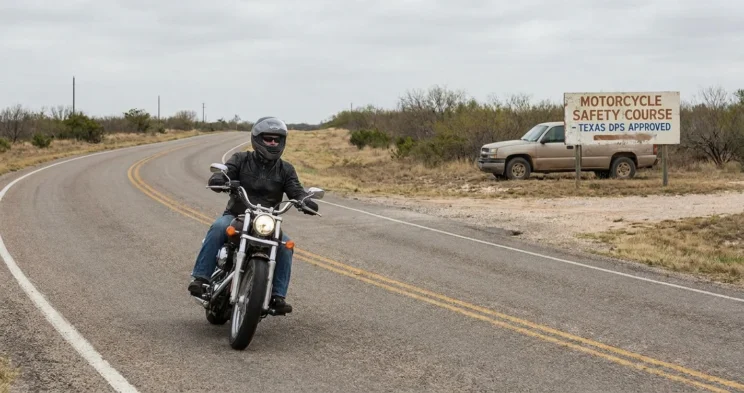
You’re heading south on I-35 on a clear Saturday morning, going from Austin to San Marcos. The throttle is relaxed and the road is open. Then a car in the oncoming lane slows down to turn left across your path. The driver looks right at you, but turns anyway.
Moments like this are how most serious motorcycle crashes begin. Knowing how to avoid motorcycle accidents before they happen is the difference between a close call and hospital bed.
Why Texas Roads Are Dangerous for Riders
We found that TxDOT data reported 574 motorcyclists died in Texas in 2025, and 2,518 riders suffered suspected serious injuries. But these numbers are not spread evenly across riders and roads.
Compared to the amount of miles they travel, motorcyclists have a high death rate in traffic crashes. While cars protect riders with steel, airbags, and crumple zones, motorcyclists only have a helmet and their own reflexes.
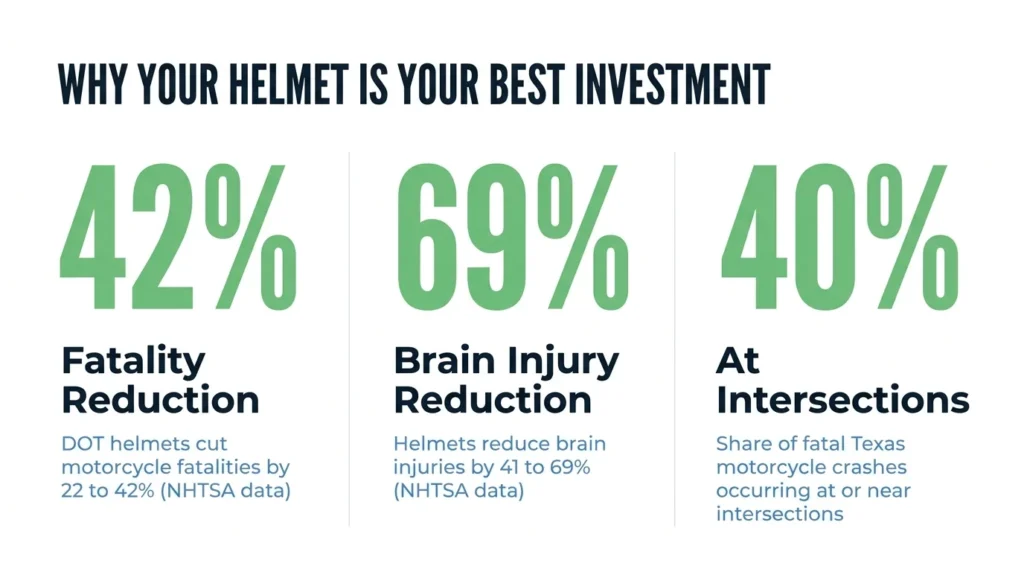
Location and timing also shape risk. About 40% of fatal motorcycle crashes in Texas happen at or near intersections, occurring more frequently from May to October.
But deaths aren’t always random. It’s important to know where danger happens so you can avoid it. If you want the fuller picture, our breakdown of recent Texas motorcycle accident statistics shows how these crashes cluster by time, place, and cause.
Top Causes of Motorcycle Crashes in Texas
Most serious motorcycle crashes result from four recurring scenarios. Avoiding motorcycle accidents starts with recognizing each one before it happens to you.
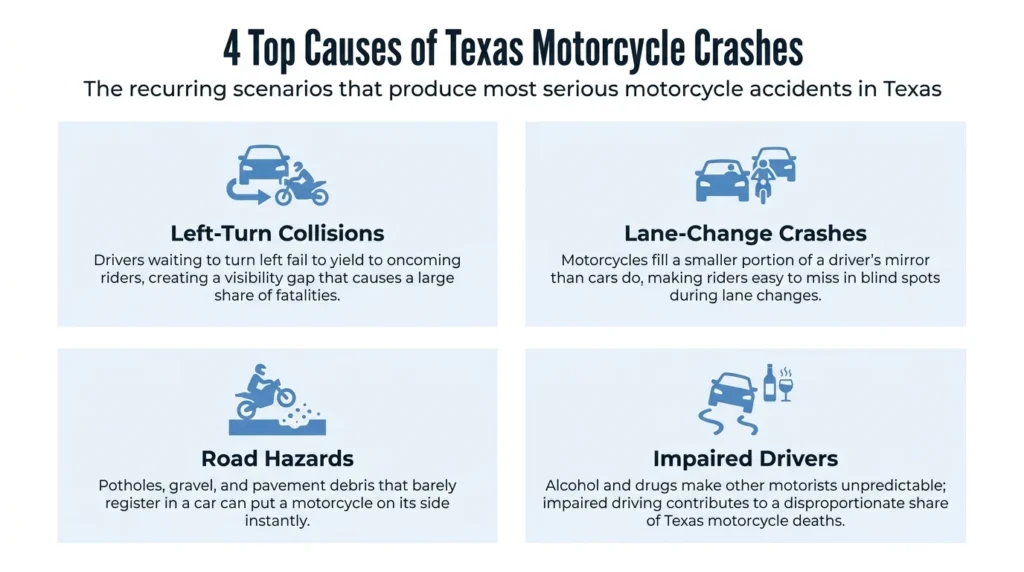
Left-turn collisions often result in deaths. A driver waiting to turn left can fail to yield to an oncoming motorcycle, often because they never saw it. This visibility gap accounts for a large share of multi-vehicle motorcycle fatalities.
Lane-change crashes follow the same logic. Your motorcycle fills a smaller part of a driver’s mirror than a car, so you vanish into blind spots. The driver’s inattention does the rest.
Road hazards are a danger unique to two wheels. A pothole, a patch of loose gravel, storm debris, or an uneven pavement joint barely registers in a car. But this same hazard can put a motorcycle on its side, and Texas road conditions vary widely from one region to the next.
Impaired drivers round out the list. Alcohol and drugs make other motorists unpredictable, so impaired driving contributes to a lot of Texas motorcycle deaths each year. Drunk driving crashes have been climbing across the state, a trend we track in our look at rising drunk driving accidents across Texas.
If another driver’s negligence caused your crash, one of our attorneys can help you understand your options for motorcycle accident claims, without any upfront cost.
Protective Gear That Reduces Specific Injuries
The right gear is your last line of defense. Each piece guards against a specific kind of harm. A DOT-certified helmet built to the federal FMVSS 218 standard is the most effective item you can wear.
Research the NHTSA shared found helmets can cut motorcycle fatalities by roughly 22 to 42% and reduce brain injuries by 41 to 69%. No other gear comes close to that kind of protection.
Texas law sets a floor on helmet use. Riders under 21 always have to wear a helmet, per the Texas Motorcycle and Moped Operation rules in the Texas Transportation Code section 661.003. Riders 21 and older may skip the helmet only if they’ve completed an approved safety course or have qualifying health insurance.
Even if you qualify for the exemption, a helmet meeting the FMVSS 218 standard is a smart choice. The legal minimum and safe choice are not the same thing.
The rest of your gear prevents injuries the helmet cannot. A riding jacket and pants made with impact-resistant materials guard against road rash and deep abrasions, as well as some fractures to your arms, legs, and torso.
Gloves matter more than riders might expect. When you fall, your instinct is to throw your hands out, which puts your palms and wrists directly in harm’s way.
Over-the-ankle boots protect feet and exposed ankles in low-speed tip-overs and contact with the pavement. Sneakers offer almost none of that protection.
High-visibility gear guards against left-turn and lane-change crashes. Bright colors and reflective material make you hard to miss, preventing a common way riders get hurt. The injuries riders actually face is explained in our guide to common injuries in motorcycle accidents.
Defensive Riding Strategies That Prevent Crashes
The best gear in the world cannot replace habits that keep you out of a crash. These defensive riding tips come straight from NHTSA safety guidance and how experienced riders approach the road.
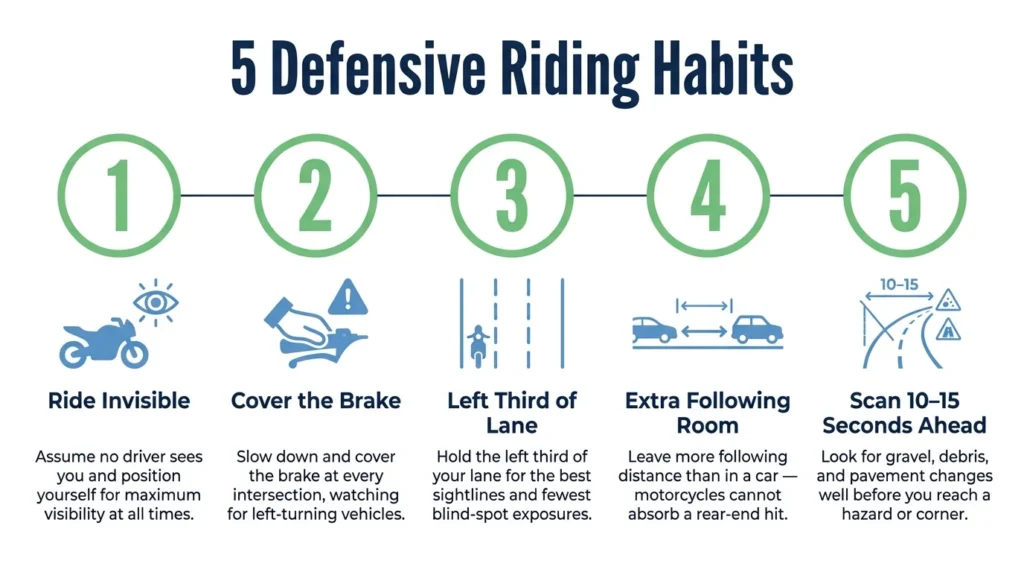
Step 1: Ride as if you’re invisible. Assume no driver sees you, position yourself for maximum visibility, and never linger in trucks’ or large vehicles’ blind spots. NHTSA motorcycle safety guidance builds its core advice around this mindset.
Step 2: Slow down and cover the brake at every intersection. Watch for cars setting up for a left turn across your path, and never assume a driver who’s stopped will actually yield to you.
Step 3: Hold the left third of your lane on straightaways. This position gives you the best sightlines and keeps you out of the worst blind spots. You should also shift within the lane as traffic around you changes.
Step 4: Leave more following distance than you would in a car. A motorcycle can stop quickly, but it cannot absorb a rear-end hit the way a car’s frame can, so give yourself room to react.
Step 5: Scan 10 to 15 seconds ahead for surface trouble. Look for gravel, debris, and pavement changes, and slow down before you reach a corner rather than braking in the middle of it.
Step 6: Take an approved rider training course. A motorcycle operator course approved under Texas Transportation Code Chapter 662 builds defensive habits and qualifies riders over 21 for the helmet-law exemption.
What to Do If a Crash Happens Anyway
Even a careful rider can get hit, so the steps you take in the first hour matter. Unless staying puts you in more danger, stay at the scene, call 911, and report the crash. Texas law requires reporting any wreck involving injury or significant property damage.
Get medical attention even if you feel fine. Adrenaline hides pain after a crash, and serious symptoms can surface hours or days later. A documented evaluation also creates the injury record you may need.
Gather what you can while the scene is fresh. Take photos of vehicle positions, road conditions, and damage. Also collect the other driver’s insurance and license details.
Be careful with insurance adjusters. Do not give a recorded statement before you talk to an attorney, because the adjuster works for the insurer’s bottom line, not you.
Speaking with an attorney before engaging with an insurance company costs nothing upfront and can protect your right to full compensation, a process we explain in how motorcycle accident settlements work in Texas.
Understanding the real risks can also help you ride with clearer eyes. Our look at what percentage of motorcycle accidents are fatal puts the danger in perspective without using scare tactics.
Were You Injured in a Texas Motorcycle Crash?
A crash can leave you facing medical bills and lost income through no fault of your own. Angel Reyes & Associates has guided injured Texans through situations like this for over 30 years. Our team of experienced injury attorneys an also review your case at no cost.
We work on contingency, which means there’s no fee unless we win. We’ve recovered more than $1 billion for clients across Texas. Our attorneys handle the insurance pressure so you can focus on healing. Reach out for a free consultation to understand your options after a motorcycle crash. We serve riders across the entire state and are available 24/7.
Past results do not guarantee future outcomes.
Avoiding Accident FAQs
Is lane splitting legal in Texas?
No. Texas law prohibits lane splitting. A 2023 law made it explicitly illegal for a motorcyclist to ride between lanes of traffic moving in the same direction, with fines up to $175 for violations.
Do I need special insurance to ride a motorcycle in Texas?
Texas requires motorcyclists to carry minimum liability coverage of $30,000 per person and $60,000 per accident for bodily injury, plus $25,000 for property damage. Insurers must offer uninsured motorist coverage, though you may reject it in writing.
How long do I have to file a claim after a motorcycle accident in Texas?
Texas gives you two years from the crash date to file a personal injury lawsuit, under Texas Civil Practice and Remedies Code section 16.003. Missing that deadline typically means losing the right to seek compensation.
Do I need a motorcycle license in Texas, or does a regular driver's license cover it?
A standard Texas driver’s license doesn’t cover operating a motorcycle. You need a Class M license or a motorcycle endorsement on your existing license, which requires passing a written knowledge test and a riding skills test or completing an approved safety course.
Can wearing a helmet affect a motorcycle accident claim in Texas?
Texas follows a modified comparative fault rule, so not wearing a helmet when it was legally required could reduce your compensation if the other side argues your injuries were worse as a result. If you were legally exempt from the helmet law, that argument carries less weight.
About the Authors

Angel Reyes
Writer
Angel L. Reyes, III is the Founder and Managing Partner of Angel Reyes & Associates. A nationally recognized trial attorney and business leader, Angel has helped over 55,000 injury victims recover more than $1 billion since founding the firm in 1993. Named to the Texas Super Lawyers list annually since 2008, Angel brings Wall Street experience, Ivy League education, and a deep commitment to client advocacy. He is a frequent legal commentator and published author with extensive contributions to legal scholarship, trial strategy, and consumer protection.

Kyle Nicolas
Editor
Kyle Nicolas is the Web Content & SEO Manager at Angel Reyes & Associates. He has more than 10 years of experience as a marketing co...

Angel Reyes
Reviewer
Angel L. Reyes, III is the Founder and Managing Partner of Angel Reyes & Associates. A nationally recognized trial attorney and business...